
With a population exceeding 21 million, Karachi is not only Pakistan’s largest city — it is the backbone of the national economy. But scale alone will not define Karachi’s future success.
The Greater Karachi Regional Plan 2047 presents a critical opportunity to guide the city’s evolution from a high-output urban centre into a globally competitive, resilient, and liveable megacity. To achieve this, industrial growth must be supported by deliberate, integrated planning.
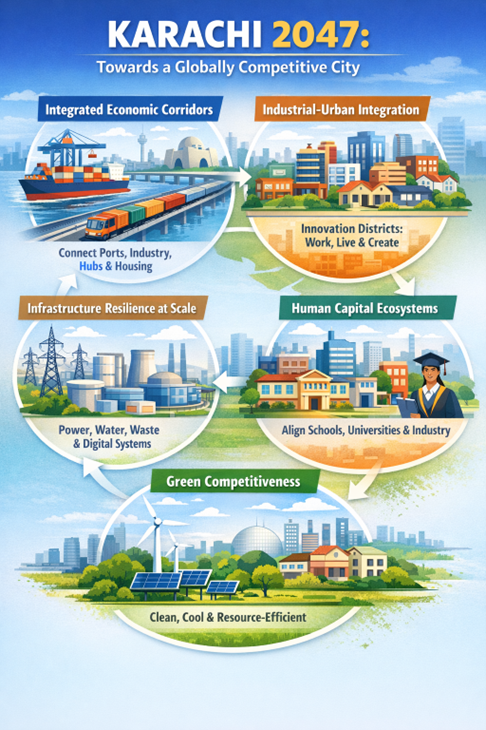
🌐Integrated economic corridors
Connect ports, industrial zones, logistics hubs, universities, and housing with high-capacity public transport and freight networks.
🏙 Industrial-urban integration
Consider how to move away from mono-uses, such as large-scale industrial estates, to centres of innovation that attract a combination of activities, potentially including manufacturing, businesses, housing, and services.
⚡ Infrastructure resilience at scale
Power, water, waste, and data infrastructure must be planned as economic enablers, not afterthoughts.
👩🎓 Human capital ecosystems
Industry cannot grow without talent. Karachi needs district-level alignment between schools, universities, and employers.
🌱 Green competitiveness
Future investment will flow to cities that are cleaner, more temperate, and more resource-efficient. Environmental performance is now an economic strategy.
Karachi’s advantage is not just its size — it is its potential to become South Asia’s most diverse industrial and innovation hub. The Regional Plan is our opportunity to design that future with purpose.
What single change do you believe would most improve Karachi’s long-term competitiveness?